How to organize a casual badminton afternoon in a small backyard
· Editorial team denvernewslucy.com
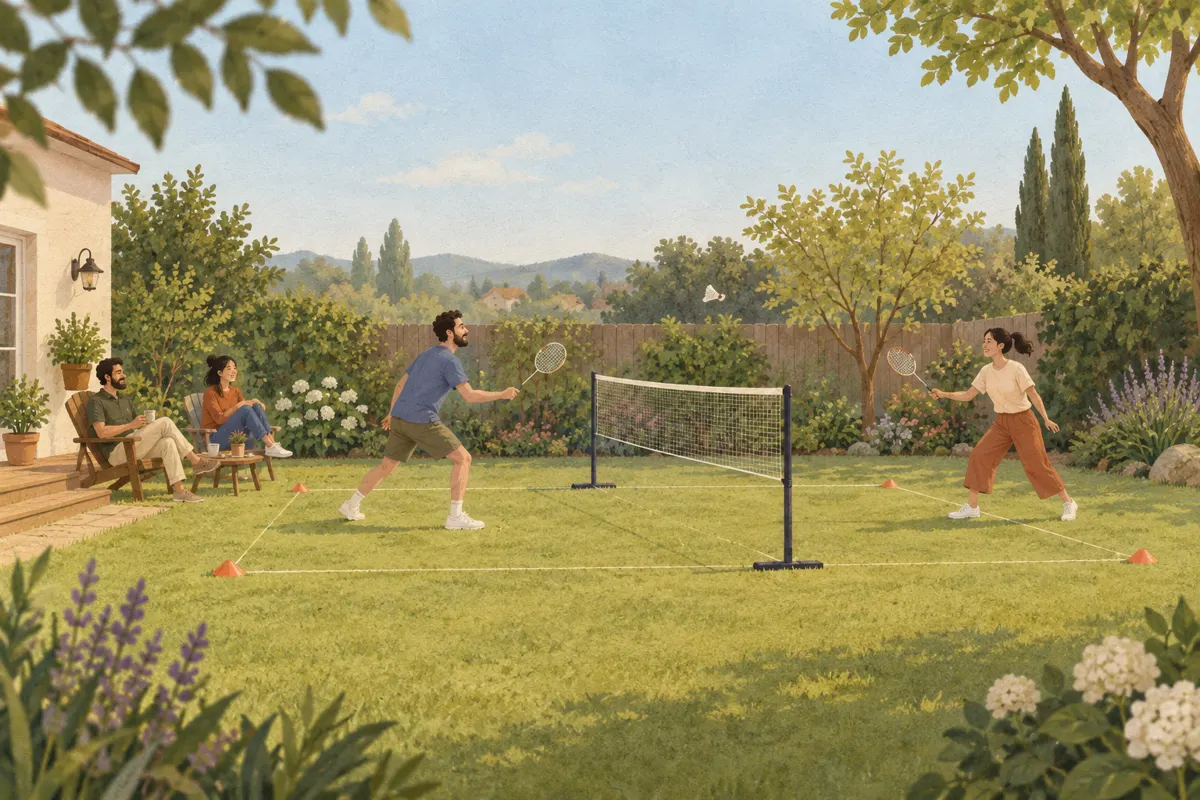
To organize casual badminton in a small backyard, clear a suitable playing area, mark boundaries that fit your space, and agree on simple rules before starting. Keep rounds short and rotate partners so everyone gets a turn. The compact layout and game formats below are editorial proposals for a relaxed afternoon, rather than official badminton rules.
Choose the playing area before setting up
Start with the ground, not the net. Walk across the proposed playing area and check for slippery patches, holes, exposed roots, loose objects, and low branches. Backyard players in the supplied forum discussion describe problems with slippery footing and uneven ground, as well as interference from wind and sunlight. Treat those accounts as practical cautions when choosing your spot.
- Remove toys, garden tools, hoses, and other movable obstacles.
- Leave space between the playing boundary and fences, furniture, planting beds, or steps.
- Put chairs, drinks, and spare equipment outside the area where rackets will swing.
- Ask players to wear secure footwear suited to the surface.
If the ground is slippery or the available space forces players close to obstacles, choose another spot or postpone play. Do not assume that laying a loose mat over uneven grass makes a suitable court.
Mark a compact court that fits your yard
For this proposed casual setup, let the usable space determine the court size. Make two roughly equal halves with enough room for comfortable racket swings and small steps. A narrow yard may suit one player on each side better than doubles. Avoid squeezing four people into a space simply because four rackets are available.
- Position the net across the clearest part of the yard, following its setup instructions.
- Keep supports and any guy lines outside the playing area and away from walking routes.
- Mark the corners with flat, visible markers; use chalk if the surface is suitable.
- Agree on imaginary straight lines between the markers and whether a shuttle landing on a line counts as in.
- Try a few gentle exchanges, then adjust the boundaries if players repeatedly approach obstacles.
Without a net, you can still propose a cooperative hitting game between two marked positions. Keep the aim simple: send the shuttle where the other person can comfortably return it.
Gather the basics and start gently
Have enough rackets for the active players, a few spare shuttlecocks, and drinking water nearby. Check that racket grips feel secure and that the net is stable. Guests waiting for a turn should have a place to sit beyond the court boundaries.
Begin with a few minutes of easy movement and gentle exchanges. The supplied garden badminton article suggests a brief warm-up and simplified play. For this gathering, propose unscored practice first so beginners can try serving and returning without an immediate competition.
Wind and glare can interrupt outdoor play. If the shuttle becomes difficult to control, shorten the hitting distance or pause. There is little value in keeping score when everyone is chasing unpredictable flights.
Agree on a few friendly house rules
Explain the rules together before the first round. These proposed house rules keep decisions quick and give mixed-skill players room to learn:
- Use a gentle underhand serve from an agreed spot.
- Give beginners a second attempt when their first serve fails.
- Award one point after each rally if you are playing competitively.
- Replay a disputed landing instead of debating it.
- Stop the rally if someone enters the court or a player would need to chase into an obstacle.
- Keep shots gentle and avoid hard smashes in cramped space.
Offer a cooperative option too: count consecutive returns and try to improve the group’s previous total. Ask guests which format they prefer, and switch if scoring starts to dominate the afternoon.
Use short rounds and rotate everyone
A proposed starting format is five-minute rounds, with the current rally finished when the timer sounds. Then bring in the next waiting players. A fixed rotation makes it easier to share court time than letting winners stay on indefinitely.
- Agree on the playing order before starting.
- After each round, move outgoing players to the end of the queue.
- For doubles, change partners regularly and pair experienced players with beginners who want guidance.
- For singles, rotate both players out when others are waiting.
- Leave a brief break between rounds for water, shuttle retrieval, and boundary adjustments.
Finish with an optional cooperative rally involving whoever still wants to play. Keep participation flexible: guests can watch, rest, or skip a round without losing their place at the gathering.